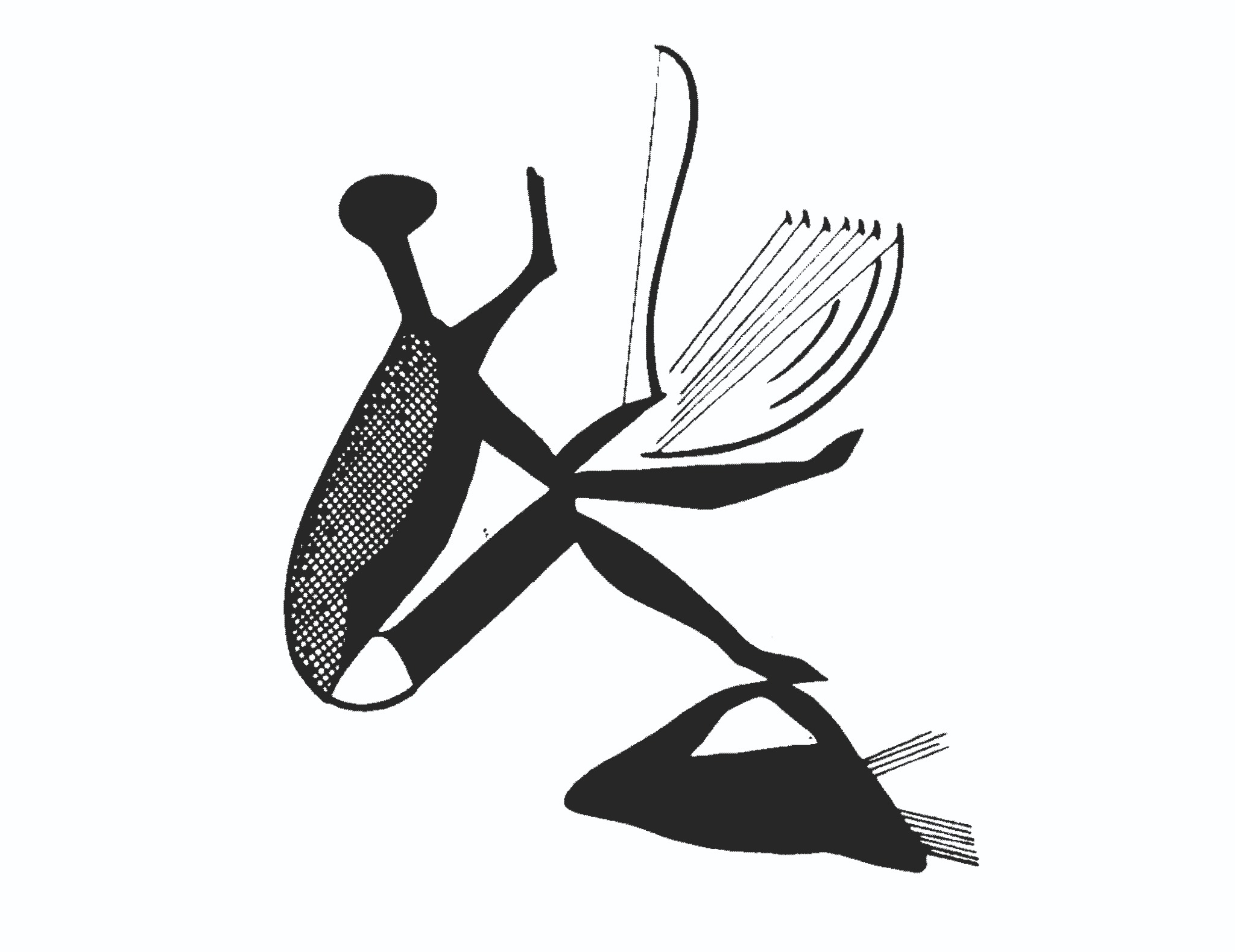
The bow is one of the most significant developments in the history of string instruments. The ability to keep a string vibrating through friction created an entirely new form of musical expression. Over many centuries, this development led to instruments such as the violin, viola and cello.
The question of the bow’s origin has still not been conclusively answered. While older accounts often described a direct line of development from the hunting bow through the musical bow to the bow for string instruments, modern research takes a much more nuanced view. Rather than a single invention, it was probably a long process involving various technical and cultural developments.
The musical bow as a possible precursor
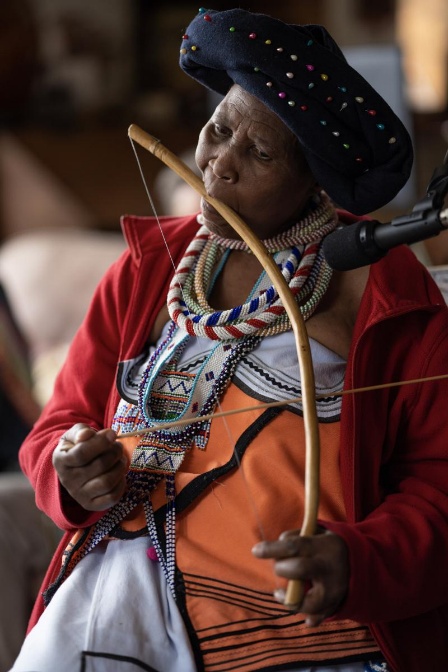
The musical bow is among the oldest known string instruments. It consists of a flexible, curved stick carrying a taut string. The string can be plucked, struck or, in certain forms, sounded through friction.
Musical bows are still found in various cultures in Africa, South America and Oceania. Their forms and playing techniques are extraordinarily diverse.
The earlier assumption that the musical bow developed directly from the hunting bow seems plausible, but cannot be proved archaeologically. As Bo Lawergren emphasises, the development of early instruments must be reconstructed with great caution from indirect evidence, since many early musical instruments were made of perishable materials and left no surviving artefacts (Lawergren, 1988).
Prehistoric images – evidence or interpretation?
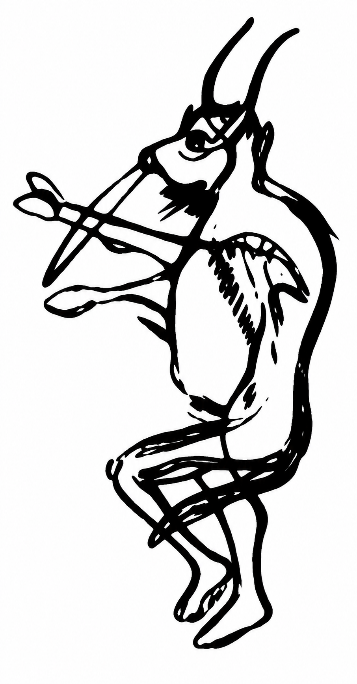
One of the best-known debates concerns an image from the Trois-Frères cave in southern France (Magdalenian, approximately 15,000–13,000 BC).
A human figure in animal disguise holds a bow-like object. Alexander Buchner interpreted this image as an early musical bow and saw it as possible evidence of an early use of the bowstring as a source of sound (Buchner, 1985).
From today’s perspective, however, this interpretation is not established. The image is highly stylised and allows several readings. As Lawergren points out, prehistoric visual sources are often problematic because modern ideas can easily be projected onto ambiguous images (Lawergren, 1988).
Nevertheless, the existence of musical bows at this early date cannot be ruled out. Their materials – wood, plant fibres and animal sinews – have very little chance of surviving in the archaeological record.
South African rock art and the limits of interpretation
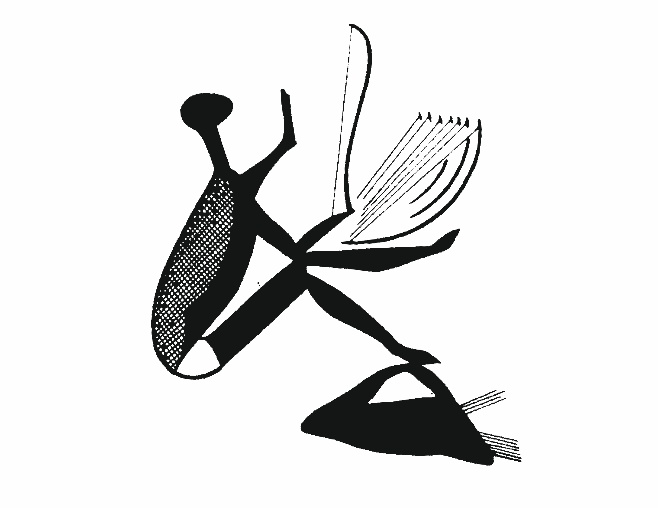
South African rock paintings have also been discussed as possible evidence of early musical bows.
Buchner interpreted an image from the Cape Town region as a musician drawing one bow across several others. From this he inferred an early form of bow for string instruments (Buchner, 1985).
Today, this interpretation is treated with considerably more caution. Although musical bows among the San are well documented ethnologically, the image does not unambiguously demonstrate that a bowed string instrument is depicted.
Modern research therefore distinguishes more carefully between:
- the established existence of musical bows,
- possible depictions of musical activity,
- and evidence of an actual bow used to play a string instrument.
The decisive development: a separate bow
The crucial difference between a musical bow and a bowed string instrument is that the playing bow does not itself carry the sounding string.
It is a separate tool that keeps a string vibrating through friction.
The older model:
Hunting bow → musical bow → playing bow → violin
is now considered too simple. Development from various forms of string instruments and playing techniques is more likely.
The transition from plucked or struck string instruments to bowed instruments probably took place where more complex string instruments already existed.
The emergence of the bow in Asia
According to current research, the first reliable evidence of bowed string instruments is found in Central Asia.
Written sources by Islamic scholars of the ninth to eleventh centuries describe instruments whose strings were sounded through friction. Werner Bachmann therefore plausibly located the origin of the bow in Central Asia (Bachmann, 1994).
Early Chinese bowed instruments are of particular importance. Chinese sources report instruments such as the xiqin, a two-stringed lute whose strings were played with a bamboo bow (Picken, 1977).
The mural at Hulbuk
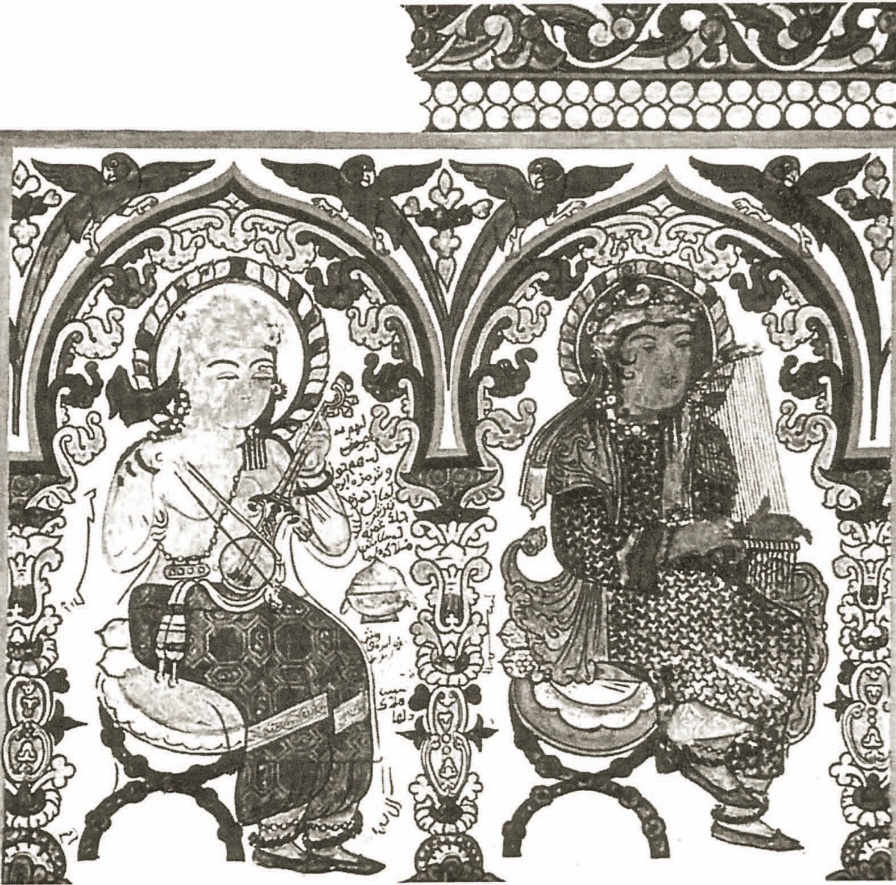
One of the most important early depictions of a bowed string instrument comes from the palace of Hulbuk in present-day Tajikistan.
The mural shows a female musician with a bowed string instrument. Created in the tenth or early eleventh century, it is among the oldest known visual records of a developed bowing technique.
The study by Siméon and Roy shows that this depiction offers new insights into the history of the rubāb and the development of early bowed string instruments (Siméon and Roy, 2018).
Further development
From Central Asia, bowed instruments spread across large areas of Asia.
Related instruments include:
- the Chinese erhu,
- the Mongolian morin khuur,
- the Indian sarangi,
- the Persian-Arabic rebāb.
Through cultural contacts and trade routes, these types of instruments eventually reached Europe. Here, instruments such as the rebec and fiddle developed during the Middle Ages, later giving rise to the violin family.
Conclusion
The origin of the bow cannot today be traced to a single moment or a single culture.
The musical bow was probably an important part of the early history of string instruments. A direct development from the hunting bow to the modern playing bow nevertheless remains a hypothesis.
The earliest secure evidence of developed bowed string instruments points to Central Asia in the first millennium AD.
The history of the bow is thus less the story of an invention than the story of a long process of cultural development.
Bibliography
Bachmann, W. (1994) ‘Bogen’, in Finscher, L. (ed.) Die Musik in Geschichte und Gegenwart. Sachteil 1. Kassel: Bärenreiter/Metzler, Sp. 1633–1646.
Buchner, A. (1985) Handbuch der Musikinstrumente. 2nd edn. Hanau: Dausien.
Lawergren, B. (1988) ‘The Origin of Musical Instruments and Sounds’, Anthropos, 83(1/3), pp. 31–45.
Picken, L.E.R. (ed.) (1977) Musica Asiatica, Volume 1. London: Oxford University Press.
Siméon, P. and Roy, S. (2018) ‘Sur la piste du rubāb, la peinture murale de Hulbuk (Tadjikistan, XIe siècle): nouvelles approches ethnomusicologiques et iconographiques’, Arts Asiatiques, 73, pp. 5–24.